Computing
Computing at SFH
Intent
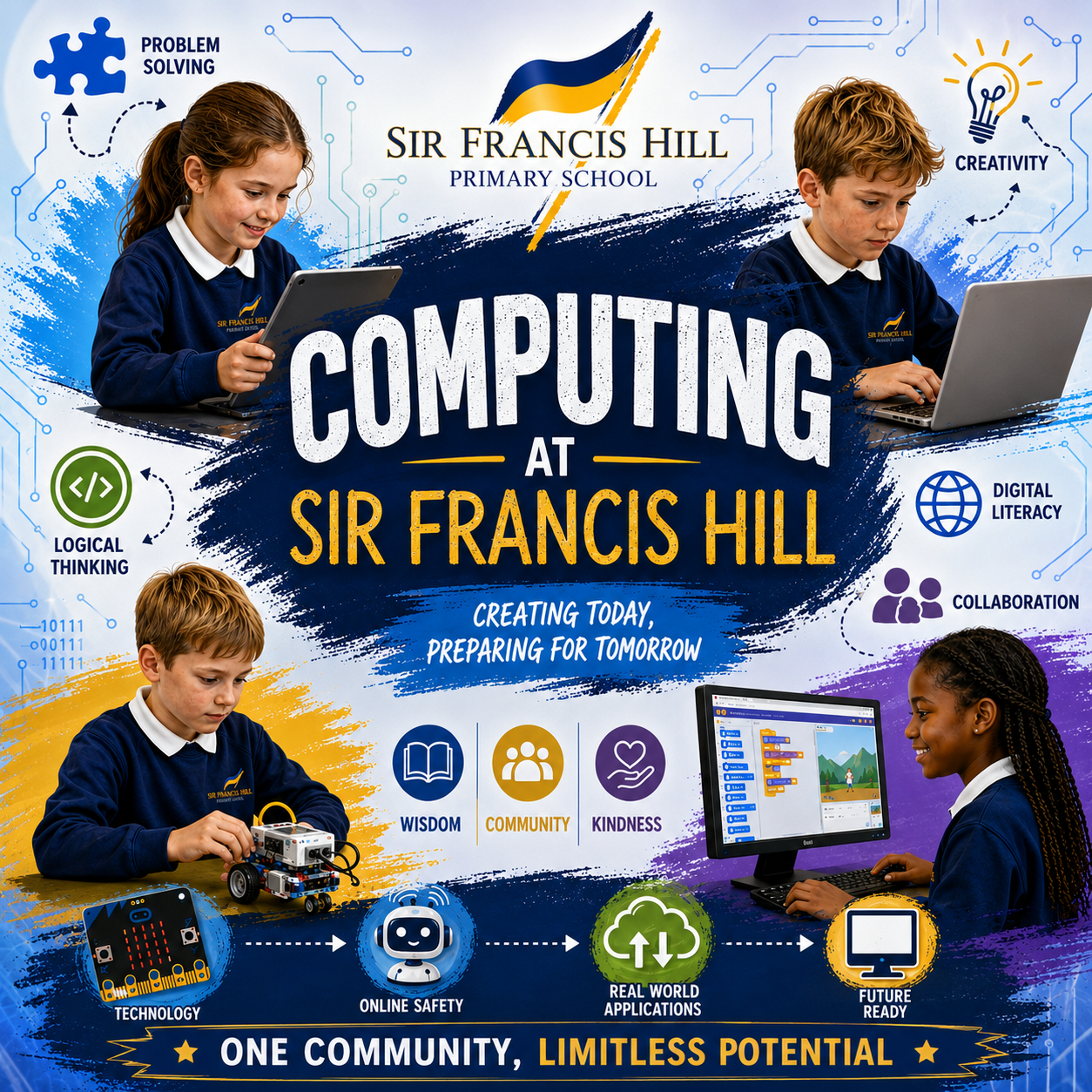
At Sir Francis Hill Primary School, we believe that Computing is an essential part of preparing children for life in an increasingly digital world. Our aim is to develop confident, creative, responsible and independent learners who understand how technology works, how it can support their learning and how to use it safely and effectively.
Our ambitious and inclusive Computing curriculum develops children's knowledge and understanding of the three key strands of Computing: Computer Science, Information Technology and Digital Literacy. Through a carefully sequenced curriculum, pupils develop computational thinking, problem-solving and digital skills, building on prior learning as they progress through school.
We want children to become creators, not simply consumers, of digital technology. They are encouraged to explore ideas, solve problems, think critically and select appropriate digital tools for different purposes.
Reflecting our school values of Wisdom, Community and Kindness, we teach pupils to make informed decisions, collaborate respectfully and behave responsibly in digital environments. We aim to equip every child with the knowledge, skills and confidence to participate safely and positively in the digital world.
Implementation
Computing is taught through discrete, carefully sequenced lessons, using the NCCE Teach Computing curriculum as the foundation for our teaching. This ensures progressive coverage of the National Curriculum while providing opportunities to revisit, consolidate and apply knowledge and skills.
Across Key Stages 1 and 2, children develop their understanding of computer systems and networks, programming, data and information, digital media and the purposeful use of technology.
In Key Stage 1, pupils begin to understand technology in their everyday lives, develop basic digital skills and explore algorithms and programming through practical activities, including programmable devices. They learn to create digital content and use technology safely and respectfully.
In Key Stage 2, pupils build on these foundations, developing increasingly sophisticated programming skills, understanding computer networks and exploring how information is stored, organised, communicated and presented. They create digital content for different audiences and purposes, using a growing range of applications and devices.
Lessons incorporate explicit teaching, modelling, practical exploration and opportunities to revisit previous learning. Pupils are encouraged to explain their thinking, evaluate outcomes, identify errors and improve their work.
We are committed to ensuring that Computing is accessible to all pupils, including those with special educational needs and disabilities. Teaching is adapted through appropriate scaffolding, accessible resources, additional support and opportunities for challenge, enabling all children to achieve success.
Online safety and digital citizenship are embedded throughout our curriculum and reinforced through PSHE. We use ProjectEVOLVE, informed by the UK Council for Internet Safety's Education for a Connected World framework, to support age-appropriate learning about privacy, online relationships, digital wellbeing, misinformation and responsible behaviour.
As technology evolves, pupils are also introduced to age-appropriate discussions about artificial intelligence and emerging digital technologies, developing an awareness of their benefits, limitations and responsible use.
Computing skills are reinforced through purposeful cross-curricular opportunities, enabling children to apply their knowledge in meaningful contexts.
Teachers use questioning, observation, discussion and practical outcomes to assess understanding, identify misconceptions and inform future teaching.
Impact
By the time children leave Sir Francis Hill Primary School, they will have developed the knowledge, skills and confidence to use technology independently, creatively, safely and responsibly.
Pupils will be able to:
-
Understand and apply key concepts of computer science, including algorithms, programming and logical reasoning.
-
Use a range of digital devices and applications confidently and purposefully.
-
Create, evaluate and improve digital content for different audiences and purposes.
-
Apply computational thinking and problem-solving strategies to unfamiliar challenges.
-
Explain their learning using appropriate computing vocabulary.
-
Recognise online risks, make informed decisions and know how to seek help when needed.
-
Think critically about digital information and emerging technologies.
-
Transfer their digital knowledge and skills to other subjects and everyday situations.
Through ongoing assessment and opportunities to revisit learning, pupils will demonstrate increasing independence, secure understanding and the ability to apply their knowledge in new contexts.
Our aspiration is that every child leaves SFH as a confident, capable and responsible digital citizen, equipped with the foundations needed for secondary education and an ever-changing technological world.
Computing Curriculum Overview 2026-27
| Autumn 1 | Autumn 2 | Spring 1 | Spring 2 | Summer 1 | Summer 2 | |
|---|---|---|---|---|---|---|
| Year 1 | Technology Around Us | Digital Painting | Moving a Robot | Grouping Data | Digital Writing | Programming Animations |
| Year 2 | IT Around Us | Digital Photography | Robot Algorithms | Pictograms | Digital Music | Programming Quizzes |
| Year 3 | Connecting Computers | Stop-Frame Animation | Sequencing Sounds | Branching Databases | Desktop Publishing | Events & Actions in Programs |
| Year 4 | The Internet | Audio Production | Repetition in Shapes | Data Logging | Photo Editing | Repetition in Games |
| Year 5 | Systems & Searching | Video Production | Selection in Physical Computing | Flat-File Databases | Introduction to Vector Graphics | Selection in Quizzes |
| Year 6 | Communication & Collaboration | Webpage Creation | Variables in Games | Introduction to Spreadsheets | 3D Modelling | Sensing Movement |